
Richmond Previous Residents by Era
A dated address history is built in layers. Wayne County instruments can lead back to the county's founding, but the web index begins much later. Printed Richmond directories offer snapshots from the mid-nineteenth century onward. Federal census schedules fill some household gaps after their public release, while maps and permits describe the building rather than its occupants. The best source therefore depends on the year being tested.
| Richmond source | Dated reach | Access point | Evidence supplied |
|---|---|---|---|
| Recorded instruments | 1811 onward; web index from 1994, images from April 2000 | Wayne County Recorder, Doxpop, older books and microfilm | Deed parties, dates and legal descriptions |
| City directories | Selected editions from 1857 onward | State Library, Indiana Memory, Internet Archive and local collections | Dated residents, work and street entries |
| Federal census | Released schedules under the 72-year rule | National Archives and library genealogy access | Households within a dated enumeration |
| Vital and marriage indexes | Local births and deaths from 1882; marriage index 1811 through 1903 | Health Department, Clerk, State Archives and genealogy collections | Family events and relationship leads |
| Maps and municipal files | 1891 Sanborn set; city case records vary | Library of Congress, BS&A and Planning | Building, block, permit and land-use context |
For a recent Richmond address, begin with the parcel and recorder. For a nineteenth-century question, translate the street first and then compare directory, map, deed, marriage, probate, and census dates. No single row proves continuous occupancy.
Walk Richmond Deeds Backward
The Wayne County Recorder is the official keeper of deeds, mortgages, releases, plats, surveys, liens, and related instruments. The Doxpop recorded-document search supplies the online route. Its Wayne index begins in January 1994, and scanned images begin in April 2000. Earlier work moves to the Recorder's physical archive, where instruments reach 1811 and are preserved on microfilm.
- Use the Assessor, Beacon, or GIS to save the current owner, parcel or PIN, situs address, and legal description.
- Find the present owner's purchase deed. Record each grantor, grantee, instrument date, recording date, and legal description.
- Search the seller as a grantee to locate that person's earlier acquisition. Name variants and legal-description terms can break a false dead end.
- Repeat the handoff from grantee to grantor. Do not treat a mortgage party, trustee, or lien claimant as an owner.
- At the online cutoff, contact the Recorder at 401 E Main Street or use older books and microfilm. Ask for the exact tract and date range.
- Grantor and grantee
- The grantor transfers an interest; the grantee receives it.
- Chain of title
- The linked sequence of recorded transfers for the same real property.
- Legal description
- The lot, block, addition, tract, or survey language that identifies land even when a street name changes.
The index is a finding aid, not the instrument itself. Preserve the public ID, book and page when shown, document type, image status, and the date searched. Those details let another researcher reproduce the chain.
The manifest capture of the Wayne recorded-document search shows the official online starting point.

Use its result as a bridge to the recorded image or an office copy, not as proof that a deed party lived at the property.
Richmond Addresses Changed Names
Older Richmond addresses can vanish from a literal search because the street was renamed. A Morrisson-Reeves Library street-name sheet records an 1881 ordinance that used Main and Whitewater as base lines. Jackson became 1st, Green became 2nd, Washington became 3rd, and several streets were combined into numbered routes. Broad and Spring became North A, while Walnut began the South A through South J sequence. A separate sheet documents west-side changes made in 1929.
The city also changed Liberty Pike to Liberty Avenue, North Park to Park Place, and Elm to Elm Place. Williamsburg Avenue became Bridge Avenue in 1894. Search both forms, keep the direction, and write down the wording exactly as it appeared in the old record. This geographic crosswalk is often the key to locating previous residents.
Note: A missing address may reflect a renamed street, changed number, lost directory year, or source boundary rather than an empty house.
Pair Richmond Directories and Census
Ownership is only one part of who lived here before. A Richmond city directory may list a resident, work, spouse or family notation, and street address for its publication year. A released federal census may show a household at one enumeration date. Neither should be stretched beyond that date. The Richmond city directory collections are covered separately; for address history, their job is to place dated household entries between deed transfers.
- Find the address in the closest available directory year, using both historic and modern street forms.
- Copy the name, address, work, household notation, edition, page, and every abbreviation as printed.
- Check the prior and next available editions. A one-year appearance deserves more support than a repeated run.
- Pair the directory entry with the nearest released census, then test marriage, death, obituary, probate, and newspaper indexes.
- Log conflicts rather than merging them. The deed owner, tax recipient, directory householder, and census resident can be different people.
The 1890 federal census is largely lost, which makes Richmond's 1890 to 1891 Emerson directory especially useful as a dated substitute, not as a census replacement. The State Library holds many selected editions, while Indiana Memory and Internet Archive offer some scans.
Richmond Buildings on 1891 Maps
The Library of Congress holds a May 1891 Sanborn fire-insurance set for Richmond with 29 sheets. It can establish a building footprint, use, block arrangement, construction details, and street name at that moment. It cannot identify a present owner or prove that a named person occupied the structure. Pair the right map sheet with the 1890 to 1891 directory, then move to deeds and later records.
This works especially well in Old Richmond or Starr, where historic-district boundaries offer another geographic check. The map may also reveal that a modern parcel once held several structures or that a number belonged to a different building. That context prevents a past resident from being attached to the wrong house.
Richmond Family Trail Endpoints
Marriage, vital, probate, obituary, and cemetery sources can explain why a name enters or leaves an address record. Wayne County's searchable marriage file has entries from 1811 through December 1903 and supports partial beginnings of names plus before and after year limits. See the Wayne historical marriage search as captured here.
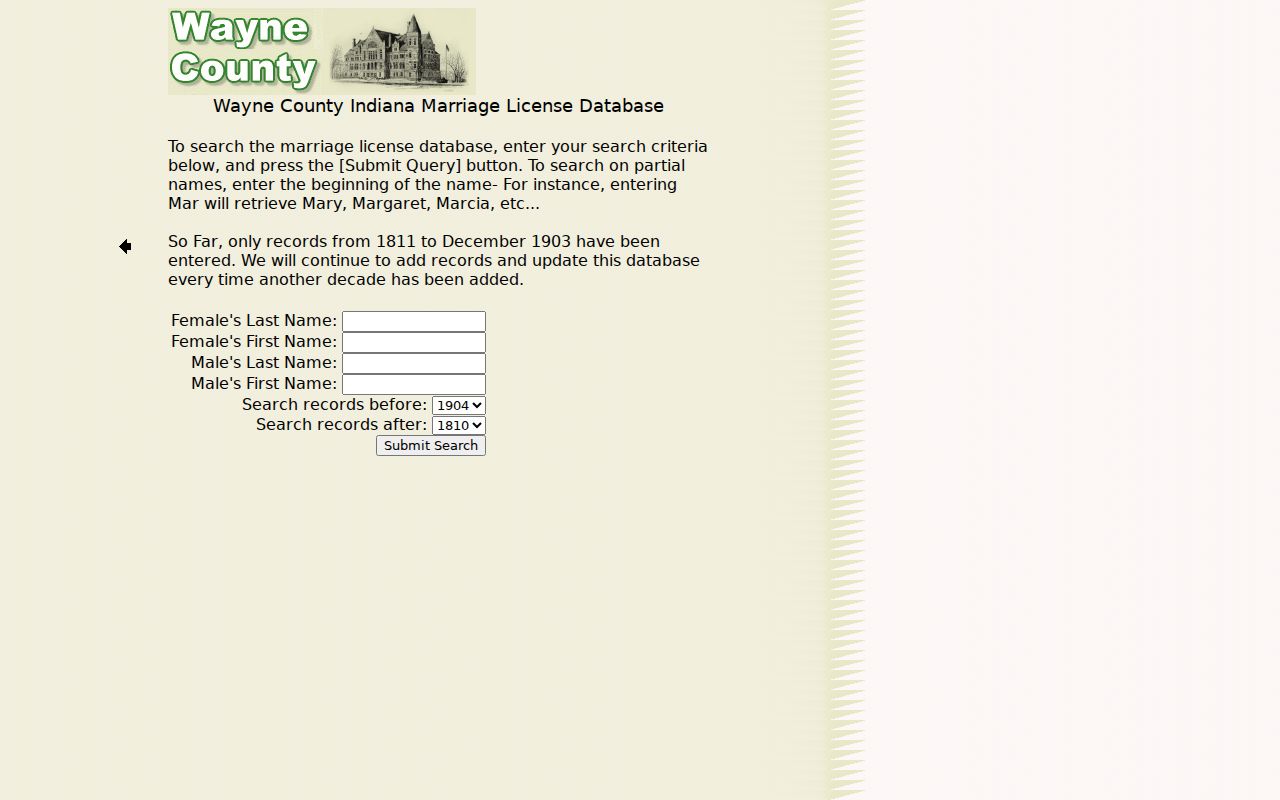
A marriage hit is a lead to the Clerk's record, not automatic proof of residence at the house.
The State Archives explains the wider route through historic birth, death, marriage, divorce, and probate material. Its vital-record holdings page provides the archival starting point.
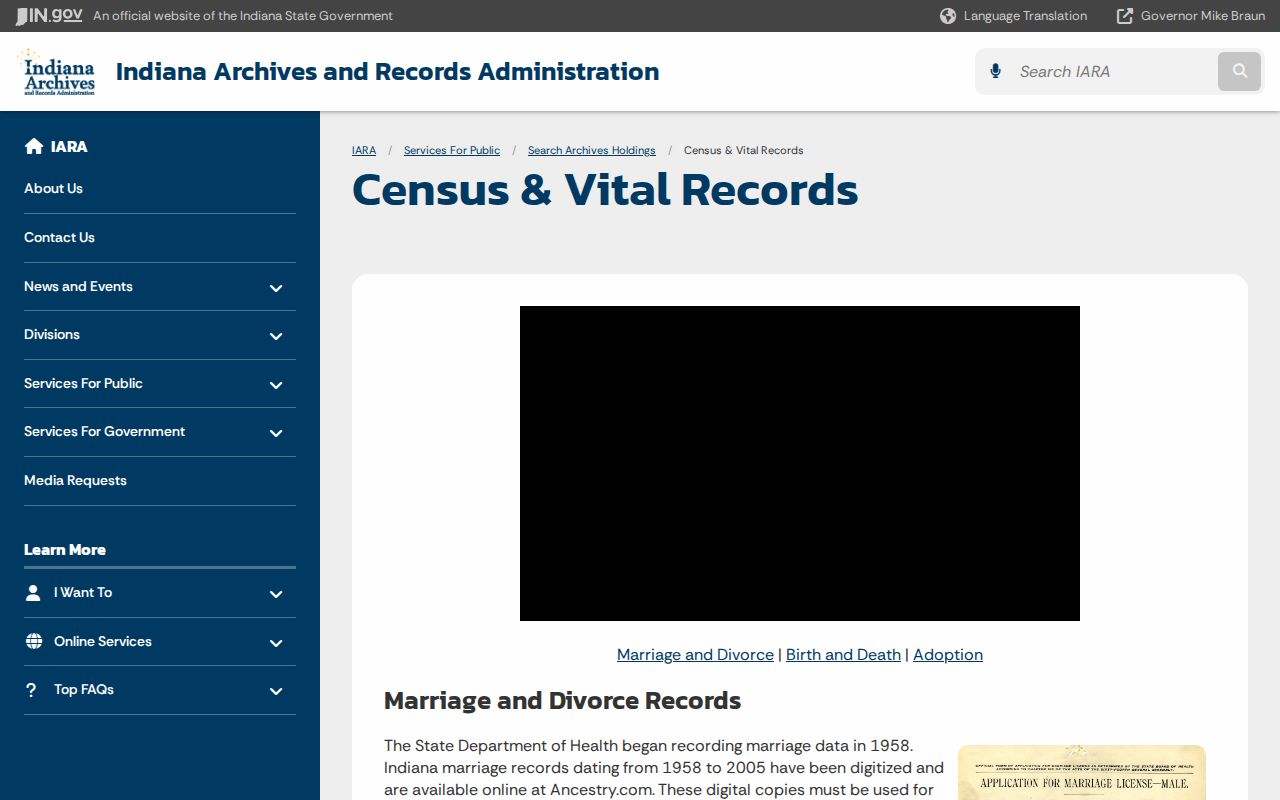
Local certified birth and death copies remain controlled by relationship, direct interest, and identification rules, so an archive lead and an official certificate are not the same product.
The FamilySearch catalog describes 130 reels of Wayne County marriage records from 1811 to 1957.
That catalog can direct a family researcher to a film and volume when the county's early web index is not enough.
Richmond House History Help
Morrisson-Reeves Library is the most focused local stop for street-name sheets, biographies, business histories, newspapers, images, and Richmond building stories. Send its archive staff a street number, old name if known, date range, and target collection. The Wayne County Genealogical Society also handles specific research requests from its Family History Library at First Friends Church. It opens Mondays from 10:00 to 4:00, except December and January.
The Wayne County Historical Museum preserves local material across an eight-building campus.

Ask for a named collection, person, place, and date. No public all-person museum index was verified.
The city side adds BS&A permits, inspections, and zoning records. Planning cases can be searched by address, owner name, or case name, with Board of Zoning Appeals history reaching back to the 1960s. These files may name an applicant or contractor, which is not the same as an occupant.
Previous Residents and Record Roles
A Richmond deed can name grantors, grantees, lenders, trustees, attorneys-in-fact, or lien claimants. The parcel layer separates an owner's name from the property's situs and the tax mailing address. A permit may name an applicant or contractor. A directory may name a householder, boarder, worker, or business. Keep each role intact rather than turning every name into a resident.
A sound evidence note uses the parcel or PIN, situs address, legal description, source date, and named role. For old work, add the original street name, modern street name, block or direction, directory or map year, and page. That method makes a Richmond address history clear enough to audit.
Respect Richmond Previous Residents
Research on past households belongs in family history, estate work, preservation, and personal curiosity. Public sources do not reveal every renter, child, visitor, utility customer, or protected person. Indiana's Address Confidentiality Program supplies a substitute address to eligible participants. Never combine that address with parcel, voter, or other records to infer a protected location.
Lawful use. Use Richmond previous-resident records for legitimate house and family history. Never track, intimidate, harass, or harm a living person.
End the search at the last source-supported fact. A gap should remain a gap. Past residents deserve the same care with names and addresses as anyone living there now.