
Richmond Directory Runs
Richmond’s historical directory shelf begins before the Civil War and continues through later issues in the Indiana State Library inventory. Some volumes are online, while others are catalog or reading-room leads. Publication was not always annual, so treat each edition as a dated snapshot rather than assuming it fills the gap to the next listed year.
| Collection | Years | Where held | Access |
|---|---|---|---|
| Richmond, Ind. Directory | 1857 | Indiana State Library | Catalog and reading-room lead |
| Sutherland & McEvoy | 1860 | State Library and Indiana Memory | Free digitized record |
| Williams’ Directory, City Guide & Business Mirror | 1863 | Indiana State Library | Genealogy collection |
| Richmond City Directory | 1881–82, 1883–84, 1886–87, 1888–89 | State Library and selected scans | Catalog, microfilm, or digital |
| Kramer Richmond and Wayne County | 1885–86 | Indiana State Library | Reading-room lead |
| Emerson Richmond City Directory | 1890–91 | State Library and Internet Archive | Free 437-page scan |
| Richmond, Ind. City Directory | 1891 and later issues | Indiana State Library | Fiche and catalog access |
| Reverse or criss-cross directories | No local run confirmed | Ask MRL, State Library, and WCGS | Request-led research |
The Indiana city directories guide places the collection in second-floor reference. Its 1890–91 Richmond call number is I 910 R532, with fiche F-4395 noted in the county inventory. Confirm current reading-room and reproduction rules before a visit.
The State Library guide appears in this collection source capture.
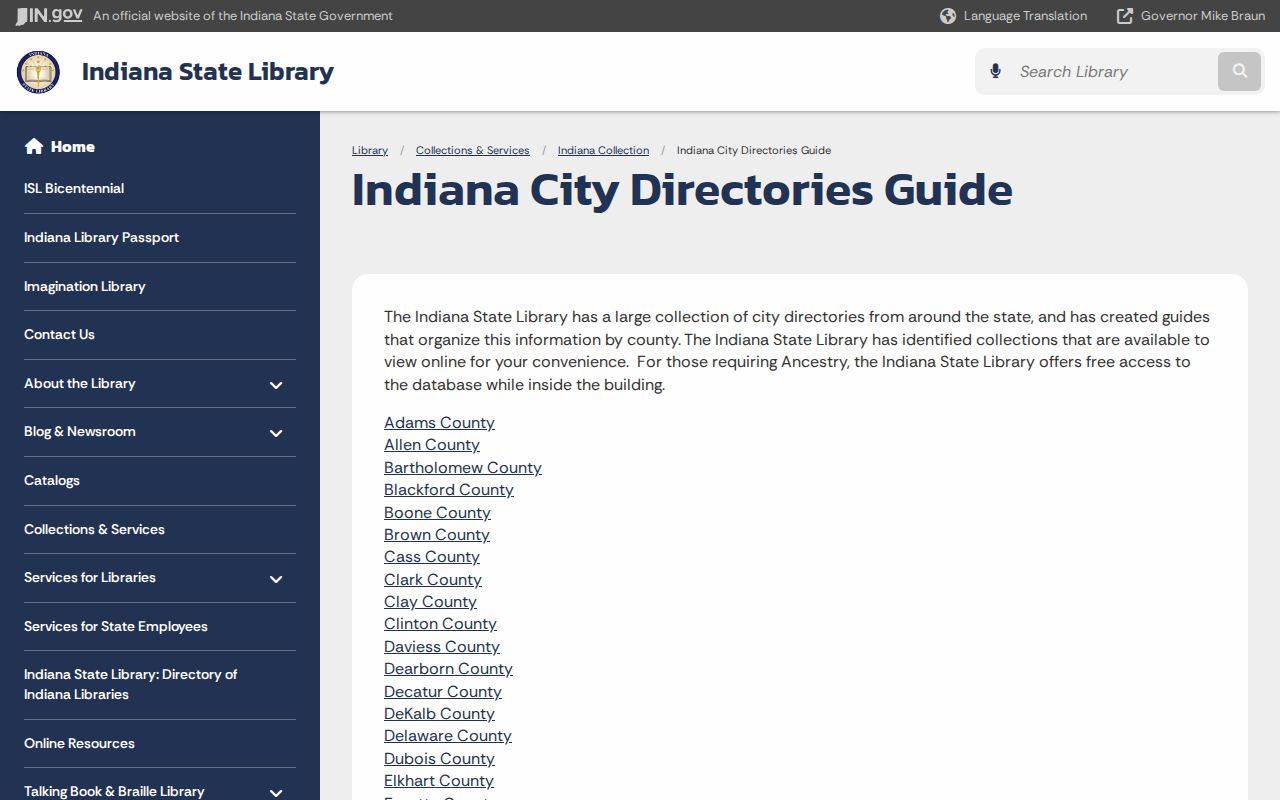
It supplies the official statewide route to the Richmond city directory holdings.
Richmond Directories Online
Two strong digital anchors allow remote research. Indiana Memory hosts the 1860–61 Sutherland & McEvoy Richmond and Cambridge City directories and business mirrors. Its metadata identifies resident listings, government information, and a classified business section. The viewer requires JavaScript, so record the item identifier and page when saving a result.
The 1890–91 Emerson directory is a 437-page public-domain scan. Its metadata describes a complete resident index, classified business directory, street directory, and Wayne gazetteer. Search OCR as a lead, then inspect the scanned page because old type, initials, and abbreviations can be read poorly by text recognition.
Open the 1860 Indiana Memory record before searching its page viewer.
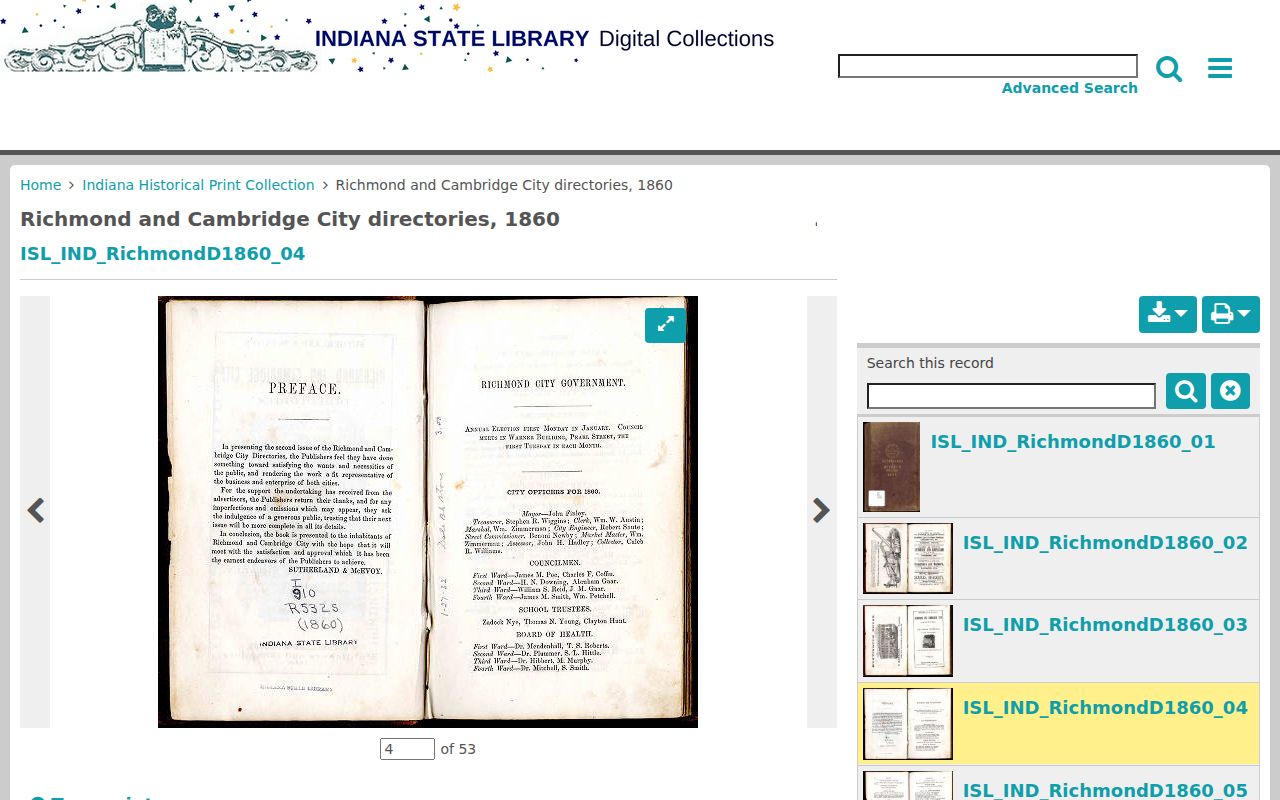
The catalog record confirms the edition and the types of directory material in the scan.
The later run is visible through the Emerson 1890–91 directory source.

Its resident, business, street, and gazetteer sections support several independent checks within one dated volume.
Read Richmond Directory Entries
An alphabetical entry is compressed evidence. Copy it exactly before expanding any shorthand. Name order, initials, spouse or family notation, occupation, firm, residence, boarding status, and widow notation may all appear. The scanned page and its abbreviation key control the meaning; do not impose a mark from a different publisher or year.
| Name | Surname, given name or initials, and any family notation |
|---|---|
| Work line | Occupation, trade, business, employer, or public office when printed |
| Address | House number and the street spelling used in that edition |
| Status mark | Residence, boarder, widow or other publisher-specific shorthand |
| Source note | Publisher, year, page, scan identifier, and access date |
A directory listing proves that the publisher associated an entry with a place at publication time. It does not prove a deed interest, exact move date, family relationship, or present residence. Compare the street section, adjacent editions, and an independent record.
- Criss-cross directory
- A later directory form arranged by street and house number, useful for looking from a place toward a listed name.
- Householder index
- An address-ordered list of household heads or subscribers, depending on that edition’s rules.
- Abbreviation key
- The publisher’s own list explaining short forms; capture it before interpreting an entry.
- Index versus image
- An index points to a record, while the scanned image preserves the printed evidence and context.
Richmond Local History Desk
Morrisson-Reeves Library, 80 N 6th Street, is Richmond’s main community-history gateway. Its local-history index covers biographies, prominent residents, businesses and industry, Lost Richmond, Palladium-Item family-tree material, street-name changes, images, and documents. The resource page also links Indiana Memory, Indiana Legacy, Hoosier State Chronicles, Chronicling America, Wayne County texts, and the Eugene “Bus” Stegall Aviation History collection.
Indiana Legacy can be browsed by county, event, surname, or record type across births, marriages, deaths, divorces, obituaries, courts, newspapers, scrapbooks, yearbooks, and military material. Exact obituary years were not exposed in the research capture. Ask the archive by name, date, place, and source type rather than assuming an all-years index.
A focused archive request should include the printed address, old street name if known, directory year, and desired collection. The archivist address is archive@mrlinfo.org, and the main number is 765-966-8291.
The available gateways are shown on the Morrisson-Reeves local-history page.
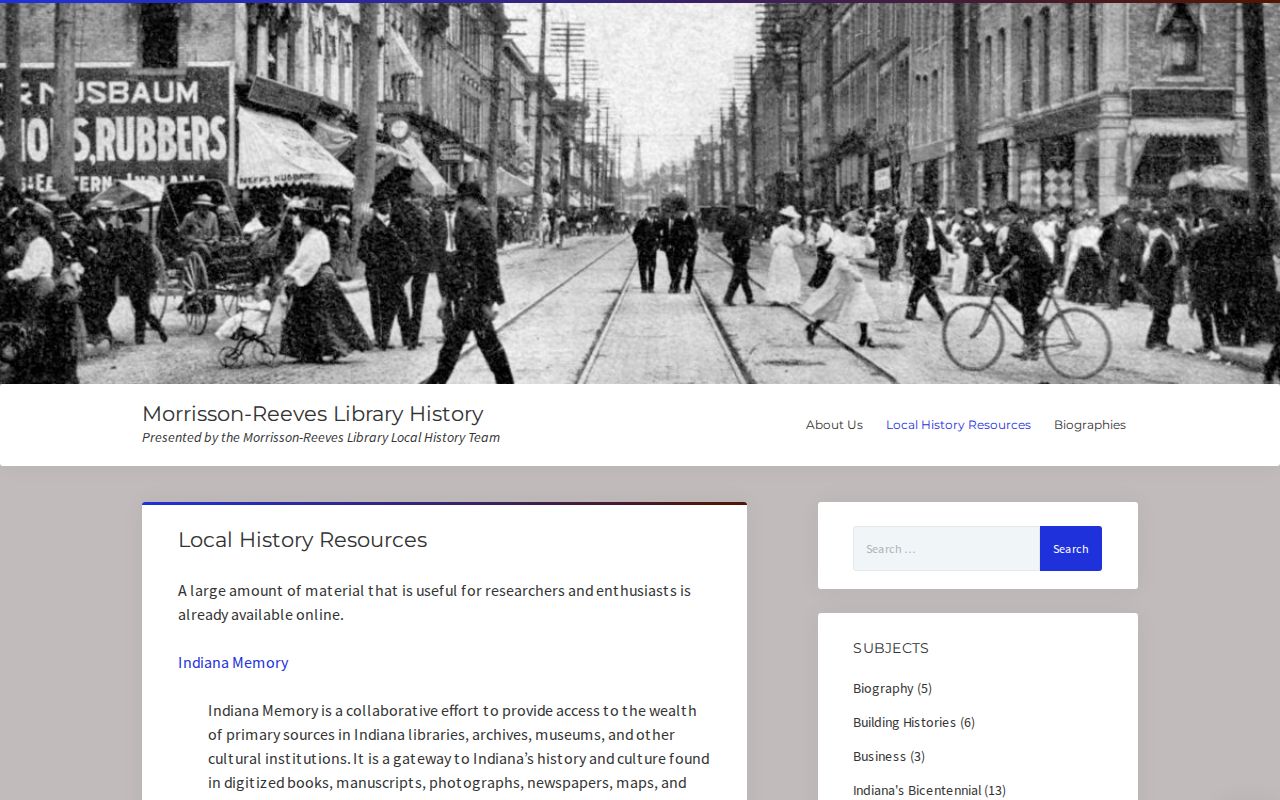
Those links extend a city directory hit into newspapers, images, yearbooks, and local collection notes.
Convert Richmond Directory Streets
The 1881 Richmond ordinance rebuilt the street grid around Main and Whitewater. Old names became numbered or lettered streets. Jackson became 1st, Green became 2nd, Washington became 3rd, and Front, Madison, or Bridge became 4th. Broad or Spring became North A; Walnut became South A. Later, Williamsburg Avenue became Bridge Avenue in 1894, and the MRL 1929 sheet records further west-side changes.
Keep both forms in the research note: the wording printed in the directory, the modern equivalent in brackets, and the crosswalk year. Try every mapped alias when OCR yields no hit. Add north, south, east, or west because the direction can distinguish separate address sequences.
This geographic step is essential for family history. A name can appear to move when only the street label changed. Conversely, a repeated house number on a renamed road may refer to the same structure, which can be tested against a Sanborn block, parcel legal description, or deed.
Note: Never silently modernize a quoted Richmond address; the source spelling and the conversion rule are both part of the evidence.
Trace Richmond Families by Year
City directories are strongest between censuses. Federal schedules become public after 72 years, and the 1890 schedule is largely lost, so Richmond’s 1888–89 and 1890–91 directories are especially useful for bridging that period. A directory remains a publisher’s snapshot, not a census enumeration.
- Find the person in an alphabetical section and copy the full entry, edition, and page.
- Check the street section for the address sequence, nearby listings, businesses, or boarding notation.
- Search the prior and next available Richmond editions, translating 1881 and 1929 street names as needed.
- Pair the result with a released census, marriage, death, obituary, deed, probate, or newspaper item.
- Record every repository, call number or item ID, page, and access date so the trail can be repeated.
A missing name has several possible meanings. The person may have moved, died, changed a surname, lived beyond the publisher’s coverage, or been omitted. Use the Wayne County marriage database, State Library WPA indexes, MRL obituary resources, and courthouse records as separate tests. Certified copies remain with the record custodian.
Family connections may also lead to the Wayne County Genealogical Society. Its Family History Library is in First Friends Church at 2010 Chester Boulevard and opens Mondays from 10:00 to 4:00 except December and January. The research committee accepts specific requests.
Map Richmond Directory Households
The May 1891 Sanborn map set contains 29 Richmond sheets. These maps show blocks, structures, uses, and street labels at a fixed date. Pair the relevant sheet with the Emerson directory from the same era. A map can test whether an address was a dwelling, shop, public building, or multi-structure parcel, but it cannot name the current owner.
Historic district boundaries create useful search areas. Old Richmond lies south of Main around South 1st through 6th. Starr covers a defined north-side area; its nomination describes 160 acres and 102 historic structures. Downtown, Reeveston, Pennsylvania Depot, and other National Register districts offer further clusters for directory, map, deed, and preservation-case research.
Parks and landmarks can serve as older search terms. Camp Wayne, Glen Miller Park, Starr Park, Hoover Cemetery, and Mary Scott Park appear in Richmond history even when a neat street address does not. Verify any person through a dated directory or archival record rather than inferring a link from geography.
Richmond Directory Record Timeline
Richmond’s directory evidence sits within a wider record chronology. Dates explain which companion source may fill a gap and which office should hold the original.
| Year | Richmond record milestone |
|---|---|
| 1811 | Wayne County formed; Recorder instruments and Clerk marriage records begin in this era. |
| 1857 | Earliest Richmond city directory listed in the State Library inventory. |
| 1860 | Sutherland & McEvoy volume now represented in Indiana Memory. |
| 1881 | Street-name ordinance supplies a key for numbered and lettered roads. |
| 1882 | Wayne County birth and death recording begins. |
| 1891 | Emerson directory and the 29-sheet Sanborn map set document the city. |
| 1929 | Later west-side street normalizations are documented by MRL. |
Later online systems do not replace the shelf. Recorder web indexing begins in 1994, images in 2000, and Richmond’s property-facing BS&A route dates to 2019. Older directories, courthouse books, and microfilm remain necessary for the years before those cutovers.
Richmond Directory Companion Sources
The Indiana State Library Wayne County guide lists pre-1906 naturalizations, first land entries, early marriages, WPA marriage and vital indexes, probate and will indexes, county microfilm, newspapers, directories, and maps. FamilySearch catalogs include Wayne marriage records from 1811–1957 on 130 reels and early probate or will leads. These are finding aids; the original custodian controls certified copies.
The Wayne County Genealogical Society maintains local books and indexes, while the Wayne County Historical Museum preserves county history across eight buildings. Neither offers a verified public all-person index. Ask a focused person, date, place, institution, or collection question.
Earlham College archives can matter when a directory entry connects to Quaker, college, or institutional history. Richmond’s community-memory layer also includes yearbooks, church materials, local newspapers, photographs, and business histories. Always date the source. A club list or school roster records one affiliation, not a complete household.
Historical and Current Richmond Directories
The present City of Richmond directory lists departments, officials, boards, and public contact channels. It is an institutional directory, not a roll of private residents. An office listing proves a public role and contact point, not that an employee lives in the city.
Historical city directories have a different purpose. They can associate a printed name, business, and address with an edition year. Compare the record types instead of blending them. The modern municipal directory helps locate the custodian for a permit, preservation case, or public-record request; the old volume helps reconstruct a dated household or business.
The current municipal source is represented in this Richmond city staff directory capture.
Its office and board contacts should remain separate from historical resident entries.
For present parcel and address evidence, follow the Richmond street directory workflow. That record chain owns the modern address angle, while the historical shelf preserves dated entries.