
Choose the Right Richmond Resident Trail
No government list names everyone who lives in Richmond. Start with the kind of fact already available. A current address points toward the Wayne County Assessor, Beacon and county GIS. A name connected with a state lawsuit belongs in Indiana MyCase. A nineteenth-century household is more likely to appear in a city directory, marriage index, deed book or newspaper than in a modern portal.
Ownership is not occupancy. A parcel result can show an owner, situs address and separate tax-billing address, yet it normally does not identify every person in the home. Indiana Voters is also narrow: an individual can confirm registration and polling information, but the service is not an open list of Richmond households. Record the source, query, date and limits with every finding.
- Normalize the name or address, including initials, suffixes and an old street name when relevant.
- Check Beacon or county GIS for a parcel, owner and separate situs and mailing fields.
- Use the Recorder’s index when a deed, mortgage, lien or other instrument could link the name and land.
- Check the proper name index, such as MyCase, the local marriage database or an official license search.
- For older years, move to Richmond directories, microfilm, maps and newspaper indexes.
- Ask the custodian for a specific existing record when a public portal is incomplete.
Where Richmond Resident Records Are Kept
Richmond is the Wayne County seat, so several key custodians sit within a few blocks of one another. Their files are not interchangeable. The Recorder indexes land instruments; the Clerk maintains court and marriage material; and the Assessor manages assessment data that feeds property-search systems. For a street-by-street method, continue to the Richmond street directory.
Wayne County Recorder
401 E Main St, second floor
Richmond, IN 47374
765-973-9235
Wayne County Clerk
301 E Main St, second floor
Richmond, IN 47374
765-973-9220
The Wayne County Recorder page provides the official route to recorded-document services.
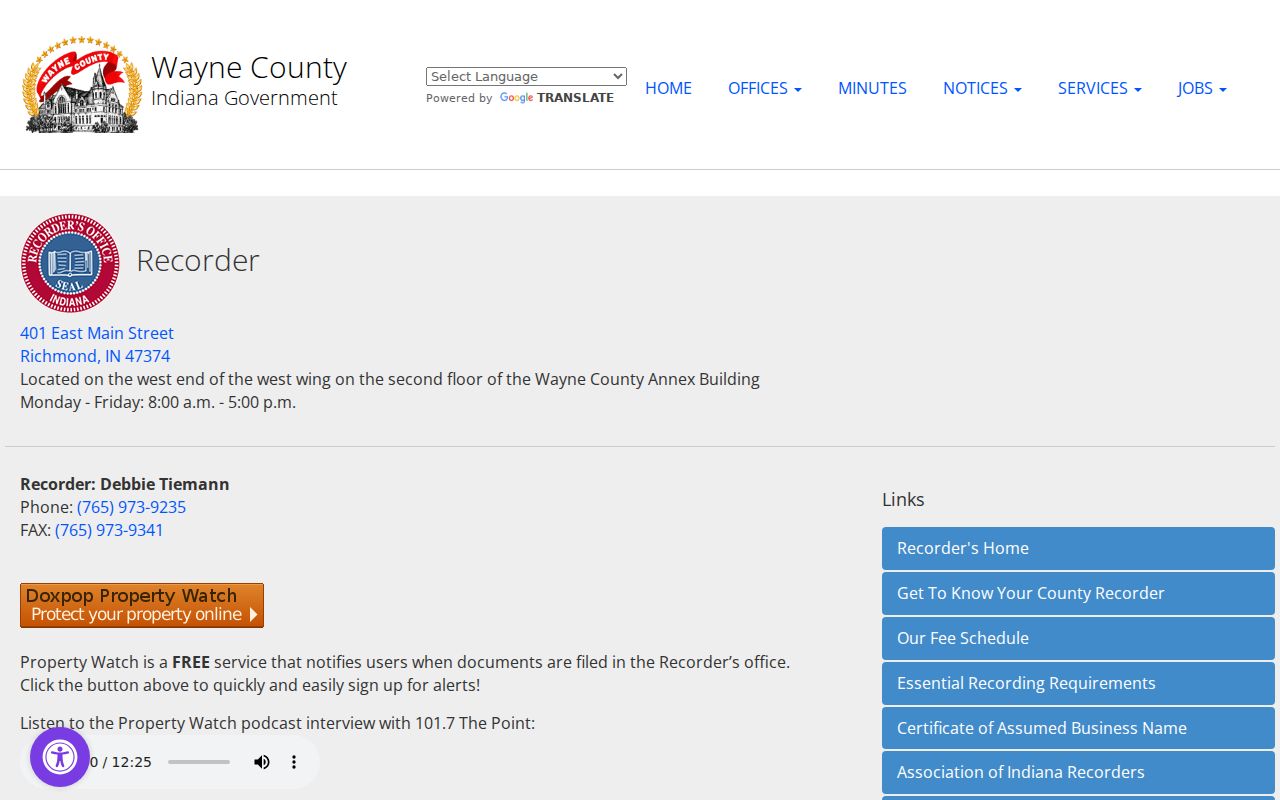
This is the right office for instruments, although an index result is a finding aid rather than a certified title search.
Separate Richmond Parcel and Mailing Fields
The Wayne County property trail works best when several official layers are compared. Beacon accepts owner name, address or parcel ID and offers routes for sales, subdivisions, sections and maps. The public Parcel Owner FeatureServer exposes owner, PIN, legal description, values, year built, acreage, situs data and billing fields. Richmond’s BS&A portal adds city building, permit, inspection, zoning and code records.
| Property field | Meaning | Caution |
|---|---|---|
| Situs address | Mapped physical location | May differ from postal or historical form |
| Owner | Name in assessment layer | Confirm changes in recorded deeds |
| Billing address | Destination for tax mail | Do not call it the owner’s home |
| Legal description | Lot, block or tract description | Best bridge to Recorder instruments |
| PIN | Local parcel join key | Preserve formatting between tools |
The Wayne County Assessor page directs readers to current assessment resources.
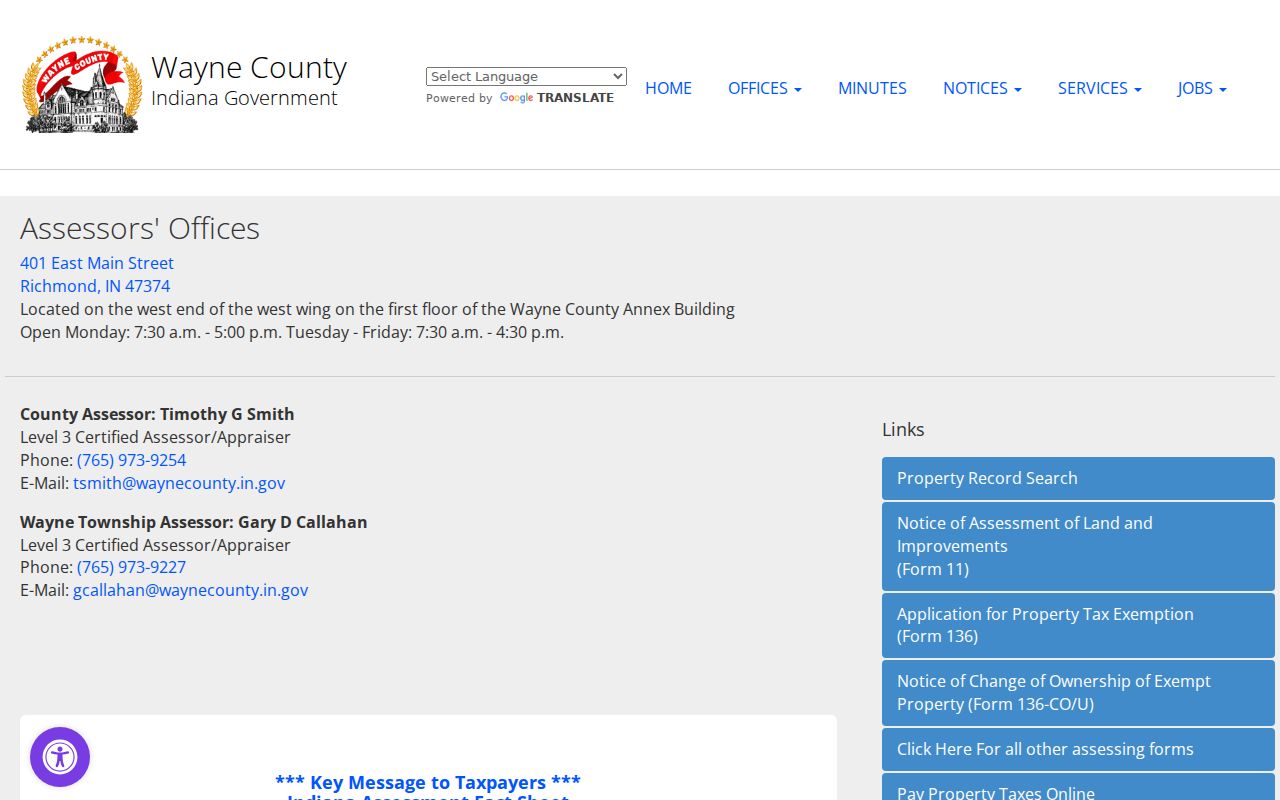
Pair the assessment snapshot with a deed number and date before reaching a conclusion about ownership.
Follow Wayne County Deeds Beyond the Web
Wayne County instruments date to 1811, but online coverage is shorter. Doxpop’s index begins in January 1994 and scanned images begin in April 2000. A blank web result before those dates is not a final answer. The Recorder’s courthouse archive, books, microfilm and State Library inventory supply the earlier path.
The inventory identifies grantor indexes for 1813–1860 and 1857–1903, grantee indexes for 1814–1859 and 1858–1887, lot indexes for 1820–1910, and deeds through 1901. Search both sides of a transfer, then carry the instrument number, legal description and book/page into the next search. Doxpop’s free Property Fraud Alert is name-based, but it is not a title opinion and may miss an instrument indexed without the expected name.
Search Richmond Court Names in MyCase
Indiana MyCase provides Case, Party/Name and Attorney routes. A party search can use last or business name, first name, middle name, date of birth, sounds-like matching, court, status and filing dates. Official tips allow a trailing wildcard, while broad searches may hit a 1,000-result cap. Wayne Circuit and Superior Courts 1, 2 and 3 entered Odyssey on July 2, 2018.
Older converted information may be partial, and a MyCase result is an index or selected electronic record rather than the complete Clerk file. Preserve the cause number and court identifier. Sealed, confidential, juvenile, adoption, mental-health, protection-order and expunged material is not a general resident source. The Clerk supplies official copies and older or unavailable files, charging the researched fees described on its access page.
Use Indiana Voters as an Individual Check
The Indiana Voters portal lets a person confirm registration, polling place, ballot and county contact information. The official workflow matches personal details such as name, date of birth and county. It should not be described as an open Richmond voter directory. Broader voter-file access follows state law, the Wayne voter-registration office and VRG-24 rules, including restrictions on eligible requesters, commercial use and redistribution.
The public portal helps distinguish this individual service from a bulk roll.
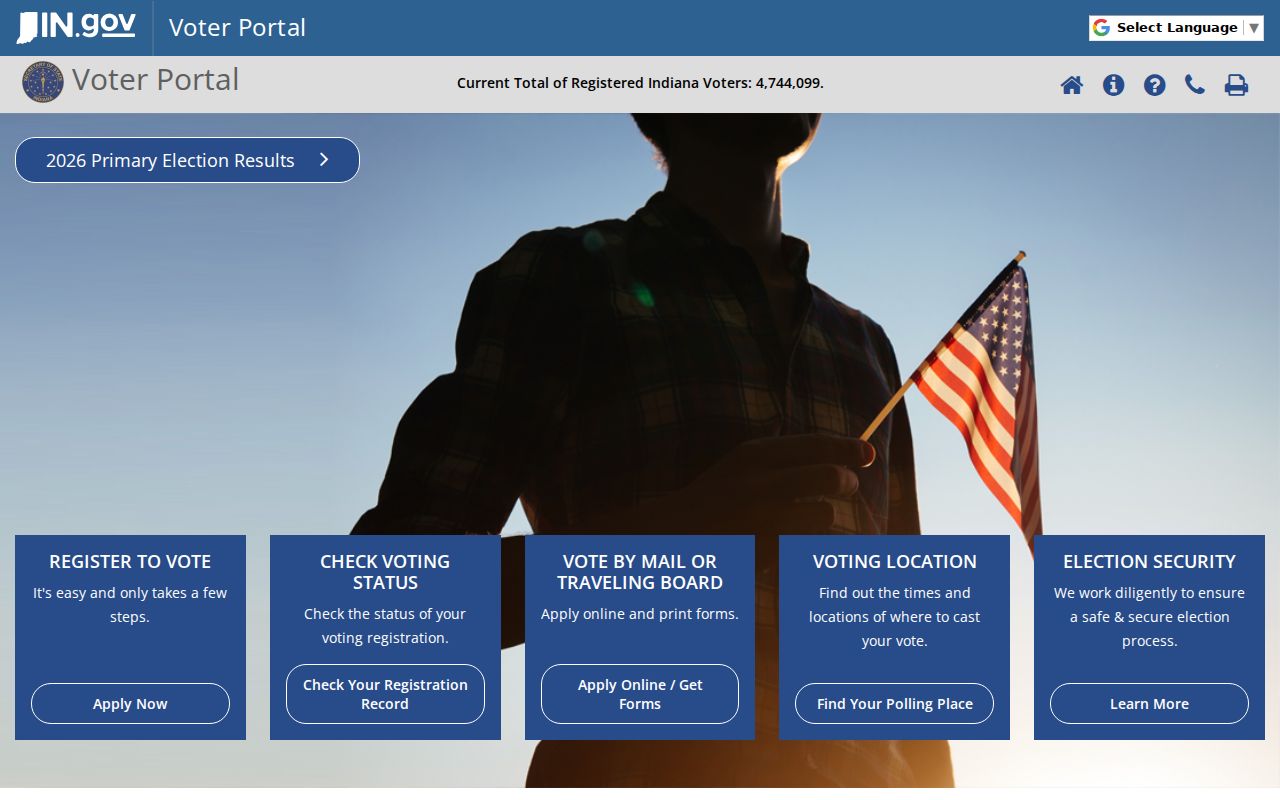
Use the result only for its stated election purpose and never try to reconstruct an address protected through Indiana’s Address Confidentiality Program.
Current Richmond Sources That Name People
Modern records list people only in defined roles. The property roll concerns assessed parcels. INBiz concerns entities and people acting as registered agents or governing persons. MyLicense verifies credentials. City staff pages identify officials through work contact. None proves a private home address.
| Local or state source | Names represented | Access | Limit |
|---|---|---|---|
| Beacon and GIS | Assessed parcel owners | Free property search | Owner may not occupy parcel |
| Indiana Voters | Individual completing a match | Registration check | Not a household list |
| Doxpop | Parties to instruments | Index and office access | Web dates narrower than archive |
| Richmond city directory | Officials and staff | Municipal directory | Official contact only |
| INBiz and MyLicense | Business and credential roles | State searches | Role-specific evidence |
For one name, the Richmond resident lookup explains how to compare results without merging different people.
Richmond Vital Records Have Access Gates
Wayne County birth and death records begin in 1882. Certified copies generally require a qualifying relationship or direct interest plus identification. County policy describes an unofficial, non-certified route, while Indiana Department of Health handles statewide orders under separate rules. Marriage research is different: Wayne County has a name-and-year database with entries from 1811 through December 1903.
Historical access dates need care. A 2025 Indiana statute opens birth and stillbirth records after 99 years, while current agency guidance includes older operational language. Verify eligibility with the custodian before paying. Adoption papers remain confidential, and birth-relative contact belongs through Indiana’s Adoption Matching Registry and confidential-intermediary process, not an ordinary public search.
Richmond Directory Books and Archive Shelves
Richmond’s directory trail begins with State Library holdings from 1857 and includes 1860, 1863, the 1880s and later editions. Indiana Memory hosts the 1860 Sutherland & McEvoy directory, described as containing residents, government and classified businesses. Internet Archive provides the 437-page Emerson directory for 1890–91, including a resident index, business directory, street directory and Wayne County gazetteer.
Morrisson-Reeves local-history resources connect those books with newspaper, biography, image and document indexes. The Genealogical Society, Historical Museum, State Library, State Archives and Indiana Legacy add microfilm and indexed material. The Richmond city directory guide covers the shelf in depth.
The library’s Richmond local-history index opens a route into old names and addresses.
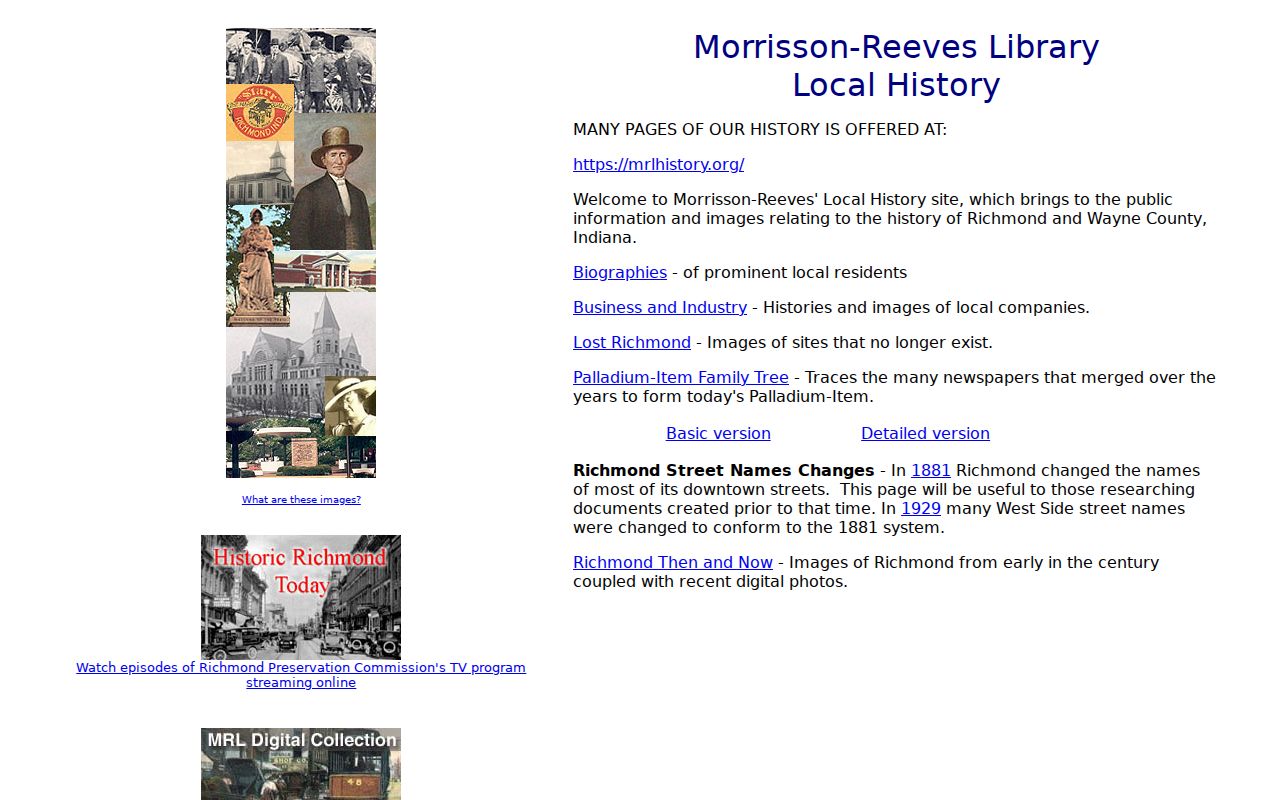
Check directory spellings and publication dates against original images and maps, especially when OCR is uncertain.
Translate Richmond’s Old Street Names
Richmond changed lettered and numbered street names through ordinances associated with 1881 and 1929. Morrisson-Reeves Library preserves conversion sheets that translate a directory, deed or newspaper address into the modern grid. Skipping this step can put the right household on the wrong modern street or hide it completely.
Preserve the original name, modern name, direction, block and source year. Then compare the 1891 Sanborn set, which has 29 sheets, with the directory year and legal description. Sanborn maps show buildings and blocks at a date; they do not name every occupant. Parcel or PIN plus situs address, legal description and date is the stronger bridge into GIS and Recorder files.
Richmond Permits Build a Property Timeline
Richmond’s BS&A system searches public assessing and building records by address, name or parcel number. Results may include permits, inspections, zoning and code activity. The Planning and Zoning Dashboard adds address, owner-name and case-name searches, with Board of Zoning Appeals history described back to the 1960s. Paper agendas and a focused city records request remain useful when a dashboard entry lacks the underlying file.
The 2019 BS&A launch and 2023 dashboard announcement mark a shift from scattered files to address-linked tools. Building activity does not establish who lived in a house, however. Treat permits as property chronology, and connect a person only through a separate directory, deed, court entry or other named record.
Know What a Richmond Result Cannot Prove
Official index: tied to a custodian, record series, coverage and stated fields. It can still be incomplete, delayed or limited to a public summary.
Commercial result: may combine copied data without showing when or why a field changed. Treat it only as an unverified lead, never as a substitute for the original.
A “no result” means only that the chosen spelling and filters found nothing in one database. It does not show that a person never lived in Richmond or that every historical volume was checked. Try documented variants, narrow the date and record type, then use the next channel: office counter, phone, mail, library, archives or a reasonably particular APRA request.
Protect People While Using Richmond Records
Indiana’s Access to Public Records Act, IC 5-14-3, supports inspection of existing public records while preserving statutory exceptions. An agency may require enough detail to identify a record, but it need not answer a general question or create a new resident list. The Indiana Public Access Counselor publishes guidance and receives access complaints.
Address Confidentiality Program participants use substitute addresses. Motor-vehicle, vital, adoption, juvenile and sealed court information also has controls. Never evade redaction, account limits, subscriptions or captcha, and never combine fragments to expose a protected person. Lawful family-history, estate, civic and property research still requires a safe stopping point when a fact is confidential or unnecessary.
Date Every Richmond Records Finding
Richmond records span courthouse books from 1811, directory shelves from 1857, county vital files from 1882, Doxpop data from 1994, scanned instruments from 2000, Odyssey court coverage from 2018 and newer city portals. “Online” never means complete across that span.
Keep a log with the searched name or address, exact portal, filters, coverage statement, access date and next custodian. Current assessment, election and ZIP guidance can change. Historical sources contain abbreviations, OCR errors and addresses that predate renaming. A dated note makes the search reproducible and supports a precise official-copy request.
For an official copy, include the identifying number found during research: a cause number for court, instrument and book/page for a deed, parcel PIN for property, or event name and date for a vital record. That detail helps the correct Richmond or Wayne County custodian locate an existing file without being asked to create a new compilation.